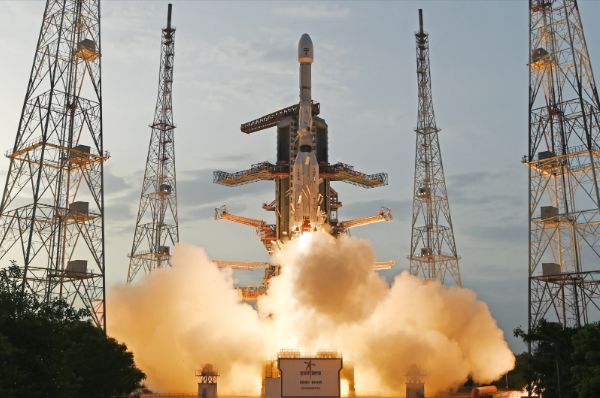
Launch of the GSLV-F16/NISAR Mission (Image Courtesy: ISRO)
The Indian Space Industry: Key Highlights from 2025
Abhishek Dubey & Sagnik Sarkar
1. Introduction
2025 has been a year of many positives for the Indian space industry. The regulatory consolidation in, and the policy and strategic focus on, the space sector that we witnessed in 2024 has begun to bear fruit. The marquee development of the year was the announcement of the winning consortium of four leading Indian space-tech startups that will build India’s first indigenous earth observation satellite constellation at an estimated project cost of more than INR 1,200 crores (~USD 130 million). Fundraises by Indian space-tech startups during the year more than doubled on a year-on-year basis, and Indian space-tech startups continued to push the boundaries of deep-tech with satellite launches and experimental tests. IN-SPACe launched a thematic fund with a corpus of INR 500 crores (~USD 55 million) to support indigenous, early-stage space technology R&D, and announced the winning bidder that will get the technology of ISRO’s small satellite launch vehicle, SSLV. Starlink secured IN-SPACe authorization to offer satellite broadband internet services (however, its spectrum allocation remains pending). Finally, ISRO qualified space docking technology with the success of the SpaDex mission and launched NISAR, one of the world’s most advanced earth observation satellites developed in collaboration with NASA. Group Captain Shubhanshu Shukla flew to the ISS aboard the Axiom-4 private spaceflight mission, marking India’s return to space after many decades.
2. Key Developments in the Indian Space Sector in 2025
2.1 Consortium of Indian space-tech startups wins bid to build India first’s indigenous earth observation satellite constellation on a PPP basis with IN-SPACe
IN‑SPACe awarded a consortium of leading Indian space-tech firms Pixxel, SatSure, PierSight and Dhruva Space India’s first PPP project to design, build, and establish, a 12‑satellite private earth‑observation constellation over the next 4 years, at an estimated project cost of more than INR 1,200 crores.
It has been reported that the consortium has undertaken to privately fund the entire cost of the project and has bid for zero financial support from the government, underscoring the confidence of the consortium in the market opportunities the consortium presents and signalling that private operators in the Indian space economy are beginning to underwrite large capex programmes based on commercial expectations.
2.2 Fundraises by Indian space-tech startups continue on an upward trajectory
Indian space-tech startups raised a cumulative amount of ~USD 170 million in equity funding over the course of 2025, compared to ~USD 70 million in 2024, which represents a ~143% increase on a year-on-year basis. While foreign capital has been instrumental in seeding early innovation in the Indian space sector, the availability of deep, patient domestic capital has hitherto been limited. Against this backdrop, the year 2025 saw the emergence of a clearer interest from deep-pooled domestic investors in investing in the space sector, offering the sector an opportunity to scale up its ambitions.
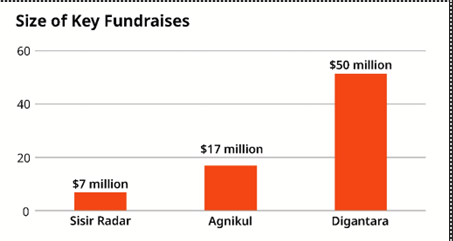
Key fundraises during the year included Digantara’s Series B round led by Reliance Strategic Business Ventures, Agnikul Cosmos’s Pre-Series C round from Artha, HDFC Bank, and others, and Sisir Radar’s Series A round led by 360 ONE:
Other space sector startups that raised funds in the year 2025 include Astrome Technologies, InspeCity, Manastu Space and Ulook Technologies.
2.3 Startups continue to push the boundaries of deep-tech with satellite launches and experimental tests of launch vehicle components
Pixxel launched three of the world’s highest resolution, commercial grade hyperspectral earth observation satellites to complete its flagship ‘Firefly’ constellation, Digantara launched ‘SCOT’, a space situational awareness (SSA) satellite that enables objects to be tracked from space, and XDLINX Spacelabs launched its demonstration satellite ‘Elevation-1’, all onboard the SpaceX Transporter-12 in January 2025.
In May 2025, Agnikul Cosmos test-fired its semi-cryogenic rocket engine, which is unique because significant parts are fabricated through ‘3D printing’ and the use of electric motors to control fuel inlets enables precise control over thrust. In August 2025, Skyroot Aerospace test-fired its solid motor, a critical component of its launcher under development, at an ISRO test facility.
2.4 IN-SPACe launches INR 500 crore Technology Adoption Fund to promote the development of indigenous space technologies
IN‑SPACe launched a INR 500 crore (~USD 55 million) Technology Adoption Fund in February 2025 to co-fund early‑stage R&D in space technologies, aimed at reducing reliance on foreign space technologies. Funding upto a maximum of INR 25 crores (~USD 2.7 million) is available per entity. Government-sponsored seed capital can be especially impactful in kickstarting the development of cutting edge, early stage technologies that may not otherwise be commercially viable, and hence this is an encouraging measure.
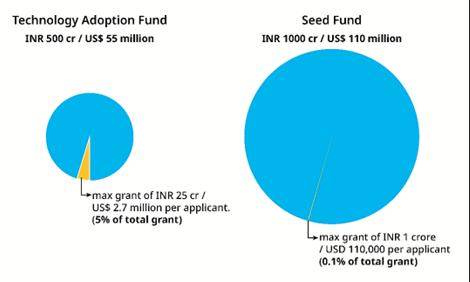
his fund complements the IN-SPACe Seed Fund Scheme, which was operationalised earlier in August 2024 with a corpus of INR 1,000 crores (~USD 110 million) to provide seed capital to eligible space sector startups by means of grants that may range upto INR 1 crore (~USD 110,000).
2.5 Karnataka, Gujarat, Tamil Nadu and Andhra Pradesh release definitive versions of their respective state space policies
Following the completion of public consultations on draft state space policies which were run through 2024, the states of Gujarat and Tamil Nadu (in April 2025), Andhra Pradesh (in July 2025), and Karnataka (in November 2025), released the definitive versions of their respective state space policies. While incentive structures differ, common classes of benefits include seed and venture capital funding, capital subsidies, availability of land at concessional charges, employment generation incentives, and reimbursement of launch costs.
The announcement of state space policies by Karnataka, Gujarat, Tamil Nadu, and Andhra Pradesh, is encouraging as it reflects growing competition amongst various states in India to leverage their unique strengths to the benefit of the commercial space industry.
2.6 Starlink secures IN-SPACe authorization
Starlink received IN‑SPACe authorisation in June 2025 to provide satellite broadband internet services in India using its Gen‑1 constellation, joining the ranks of Eutelsat OneWeb and the Reliance‑SES JV, which had secured authorisations earlier in 2024. This represents a crucial step towards the realisation of satellite broadband internet services in India.
However, the commercial launch of broadband internet services in India is contingent on each of these entities securing final spectrum allocation from the Indian government. All three entities have currently been granted trial spectrum, which only enables technical trials to be conducted.
2.7 IN-SPACe announces Hindustan Aeronautics Limited as the winning bidder for the transfer of technology of the launch vehicle SSLV from ISRO
In September 2025, IN‑SPACe named Hindustan Aeronautics Limited (HAL) as the winning bidder for the technology transfer of ISRO’s Small Satellite Launch Vehicle (SSLV). SSLV is designed to carry payloads of upto 500 kg to low earth orbit and 300 kg to sun‑synchronous orbit. Once this technology transfer is completed, the SSLV will become the first ISRO-developed launch vehicle that will be fabricated end-to-end by a non-ISRO entity.
2.8 Government space exploration missions
ISRO advanced its space exploration capabilities in 2025 on multiple counts:
2.9 Setbacks involving the Polar Satellite Launch Vehicle
The year 2025 also underscored that India’s expanding space ambitions are not without execution risk, as reflected in setbacks involving the Polar Satellite Launch Vehicle (PSLV). Two otherwise rare PSLV third‑stage anomalies occurred. In May 2025, PSLV‑C61 failed to insert the earth observation satellite EOS‑09 into orbit. Less than a year later, in January 2026, the PSLV-C62 mission carrying the EOS-N1 satellite and 15 additional payloads also suffered a critical third-stage disturbance that caused deviation from the intended flight path and loss of the mission.
Such failures are part of the normal learning curve and underscore the importance of redundancy, insurance, and risk allocation as private participation and launch cadence increase.
3. Outlook for the New Year
Industry projections indicate the global space economy is estimated to grow from ~USD 570 billion in 2023 to ~USD 1.8 trillion by 2035. India currently accounts for only 2% of this market, and Indian government policy targets aim to secure an 8% share by 2035, implying substantial headroom for investment and expansion. Momentum in the sector is expected to strengthen further in 2026, driven by increasing regulatory clarity and the space sectoral policy reforms of 2024, maturing business models, increased uptake of downstream applications, and early validation of revenue through government procurement and commercial contracts. While foreign capital will remain important, domestic strategic and institutional investors can be expected to write larger cheques, which will be critical for meeting Indian ownership and control requirements under government programmes. Given the number of satellite launches over the year, we expect Indian space-tech startups to make significant progress towards commencement of revenue generating operations.
On the space exploration front, ISRO has scheduled a launch of the human-rated variant of the LVM-3 launch vehicle, which would be a critical and exciting precursor to crewed launches.
2026 will certainly be an interesting year to watch!