Click Here to View online version
|
|
|
SIA-India Newsletter – August
|
|
|
|
|
Expanding India’s Space Economy: New Frontiers, New Capabilities, New Partnerships
|
|
|
Northeast India as Strategic Gateway to India’s Emerging Space Economy
As part of the National Space Day 2026 celebrations, SIA-India took the national space-industry dialogue beyond New Delhi for the first time, bringing together stakeholders in Guwahati for the Northeast India Space Workshop 2026, organised in partnership with the North Eastern Space Applications Centre (NESAC). Held on 26–27 August under the theme “Leveraging Space Technology: Regional Transformation to Global Reach,” the workshop examined how the Northeast could move beyond being a user of space-enabled services to becoming an active contributor to India’s emerging space economy and a strategic gateway to the Indo-Pacific.

The discussions highlighted the Northeast’s distinctive advantages, including its geographical proximity to Southeast Asia, challenging terrain, dispersed communities and vulnerability to natural disasters, as an opportunity to develop and test solutions with wider national and international relevance. A central message emerging from the workshop was the opportunity to build “space solutions from the Northeast, not just for the Northeast.” The region’s unique operating environment could serve as a real-world testbed for technologies addressing connectivity, disaster management, infrastructure and resource monitoring, while its location could help connect Indian space enterprises with markets across Southeast Asia and the wider Indo-Pacific.
The tangible outcomes of the workshop are:
- SIA-India will collaborate with the Government of Assam on the draft SpaceTech Policy, which is expected to be released shortly for industry consultation, with the aim of enabling greater industry participation in the growth of Assam’s space sector.
- SIA-India is exploring the establishment of a Centre for Space Entrepreneurship in partnership with STPI and the Government of Assam to catalyse innovation, facilitate access to funding and accelerate technology transition. The Centre would also help build linkages with SIA-India’s existing Centre of Excellence for SpaceTech in Bengaluru, Karnataka, creating stronger connections between regional innovation and the wider national SpaceTech ecosystem.
|
|
|
IN-SPACe Strengthens Regulatory Framework for Planned Space Object Re-entry
|
|
|
|
|
SIA-India welcomes the proactive move by the Indian National Space Promotion and Authorisation Centre (IN-SPACe) to introduce dedicated Norms, Guidelines and Procedures (NGP) for the authorisation of planned re-entry of space objects. The framework is an important addition to India’s evolving commercial space regulatory architecture, particularly as the sector moves towards reusable launch vehicles, return capsules, orbital servicing and other missions involving controlled return to Earth.
The Guidelines establish clear safety and operational requirements, including a 1-in-10,000 casualty-risk threshold, detailed trajectory and survivability assessments, and coordination with aviation and maritime authorities. They also provide clarity on when separate re-entry authorisation is required and prescribe timelines for planned re-entry, including a six-month advance application where the decision is taken after launch. SIA is recommending for greater procedural clarity and predictability around re-entry authorisations, review timelines, exceptional operational circumstances, risk-proportionate regulation, technical assessment methodologies, and liability and insurance requirements. The objective is to help establish a robust and predictable framework that maintains high standards of public safety while supporting innovation, investment and the growth of India’s emerging commercial re-entry and reusable-space ecosystem. SIA-India will undertake industry consultations on the Guidelines and incorporate stakeholder inputs before submitting its final recommendations to IN-SPACe.
To know more:
|
|
|
SIA-India Submits Recommendations on Draft Assam SpaceTech Policy
|
|
|
|
|
SIA-India has submitted its recommendations on the Draft Assam SpaceTech Policy, outlining measures to strengthen Assam’s emerging SpaceTech ecosystem and establish a differentiated regional proposition. The recommendations focus on setting clear state-level targets, promoting high-priority downstream applications tailored to Assam’s geographic and developmental needs, and creating an enabling framework for private investment, startups and infrastructure. SIA-India has also highlighted the importance of targeted applications in areas such as flood forecasting, erosion mapping, tea-sector analytics, wildlife monitoring and connectivity, alongside fiscal incentives and dedicated SpaceTech infrastructure to support industry growth in the state.
Read full submission at:
|
|
|
Satellite Spectrum Pricing: SIA-India Calls for a Proportionate and Development-Oriented Framework
|
|
|
|
|
The Department of Telecommunications (DoT) is reportedly leaning towards a 5% AGR-linked spectrum usage charge for satellite broadband services, with the Digital Communications Commission (DCC) expected to take up the matter as part of the broader framework for satellite spectrum assignment. A decision is also expected to address measures for encouraging connectivity in underserved and remote areas.
Against this backdrop, SIA-India has called for a proportionate and development-oriented spectrum framework, particularly as India’s commercial satcom market continues to evolve. The Association has advocated a lower initial spectrum charge to support affordability, investment and market development, while enabling satellite connectivity to complement terrestrial networks and strengthen resilience across remote, rural, border and disaster-prone regions. SIA-India has also emphasised the importance of avoiding premature capacity constraints, leveraging public funding for last-mile access and strengthening domestic capabilities across the satcom value chain. SIA-India remains committed to engaging with DoT, TRAI and IN-SPACe towards a predictable, technology-neutral and investment-friendly framework that enables satellite and terrestrial networks to work together and expands meaningful connectivity across India.
To read our comment on the consultation:
To know more:
|
|
|
Balancing Security and Commercial Growth: IN-SPACe’s New SSA Framework
|
|
|
|
|
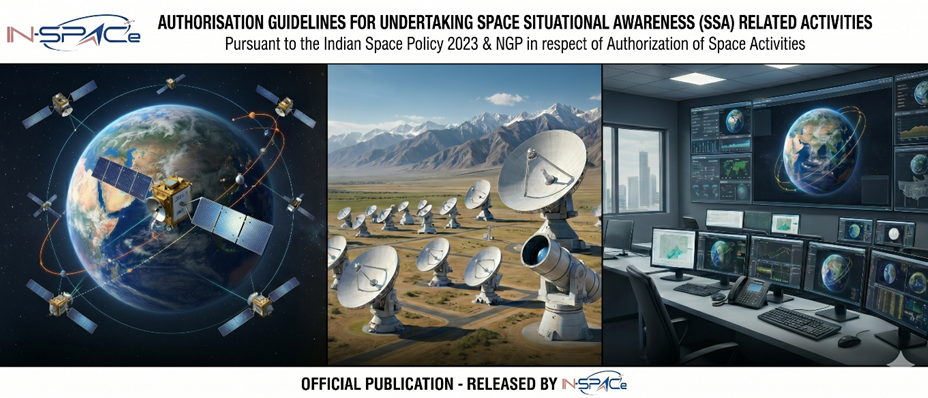
SIA-India welcomes IN-SPACe’s initiative to establish a dedicated authorisation framework for Space Situational Awareness (SSA) activities, marking an important step towards enabling greater private-sector participation in a strategically significant domain. The framework seeks to strike a balance between facilitating the growth of commercial SSA capabilities and safeguarding India’s national security, strategic interests and long-term space sustainability.
The Guidelines establish a structured regulatory framework covering authorisation, foreign participation, data dissemination, security, compliance and Government oversight, including a tiered approach for different ownership and control structures. SIA-India believes that greater clarity on areas such as foreign collaborations, data classification, security assessments, confidentiality and cross-border operations will be important for providing regulatory certainty and enabling innovative commercial models while preserving necessary Government oversight. The framework comes at an important juncture as commercial SSA capabilities are expected to play an increasingly significant role in space safety, collision avoidance and protection of critical space infrastructure. SIA-India’s submission aims to strengthen the framework while preserving national-security safeguards and Government oversight, and to ensure that the emerging regulatory regime supports responsible commercial participation and the development of a globally competitive Indian SSA ecosystem.
To know more:
|
|
|
SIA-India Seeks Regulatory Clarity for Satellite-Enabled Broadcasting Services
|
|
|
|
|
SIA-India is engaging with industry stakeholders on the Ministry of Information & Broadcasting’s draft Telecommunications (Television, Radio and Associated Services) Rules, 2026, which seek to consolidate and streamline the regulatory framework governing television, radio and associated broadcasting services. Given the implications for satellite television, DTH, HITS and other satellite-enabled broadcasting services, SIA-India is working to ensure that industry concerns are appropriately represented. SIA will also be taking up the matter with the Ministry, providing an important platform for broader industry engagement. SIA-India will continue to coordinate with relevant stakeholders and advocate for a clear, predictable and technology-neutral framework that supports ease of doing business and the continued growth of India’s broadcasting and satellite communications ecosystem.
Members are invited to share their inputs and comments at Sudipta.behera@sia-india.com and rajith.ali@sia-india.com
|
|
|
Technology and Innovation
|
|
|
|
ISRO Successfully Launches GSLV-F17 with EOS-05, Strengthening India’s Earth Observation Capabilities
|
|
|
|
|
The Indian Space Research Organisation (ISRO) has successfully launched GSLV-F17 carrying EOS-05 from the Satish Dhawan Space Centre, Sriharikota, marking an important milestone in India’s Earth observation capabilities. The mission placed EOS-05 into its intended Sub-Geosynchronous Transfer Orbit, with the spacecraft designed to become India’s first imaging satellite operating from a geosynchronous orbit. The mission is significant for its potential to provide persistent and wide-area observation capabilities, strengthening applications across weather and environmental monitoring, agriculture, disaster management and strategic requirements. The successful flight also marks the 19th mission of the GSLV, demonstrating the continued maturation of India’s indigenous launch vehicle capabilities. SIA-India congratulates ISRO and the entire team behind the successful GSLV-F17/EOS-05 mission. The achievement further reinforces India’s growing capabilities across launch services and space-based Earth observation and represents another important step in the country’s journey towards a globally competitive and increasingly self-reliant space ecosystem.
Read More:
|
|
|
SIA-India and Neel Arnav Research Launch National Initiative on Commercial Space and the Law
|
|
|
|
|
SIA-India, in collaboration with Neel Arnav Research, convened the first hybrid workshop under the “National Initiative on Commercial Space and the Law: Unique Complexities, New Questions” at the Centre for Land Warfare Studies (CLAWS), New Delhi, on 24 August 2026. The inaugural workshop, titled “Private Commercial Space Operations – General Discussion and Questions on FDI and Insurance in Space Businesses,” discussed that India’s next phase of space-sector growth will require greater regulatory certainty, access to capital, effective risk management and institutional confidence, alongside technological capability. Key conversations examined national laws applicable to space businesses, insurance and liability, foreign investment and business structuring, while also highlighting gaps in the existing framework that can affect investment, innovation and operational scalability.
Participants also discussed the importance of stronger engagement with international space-law frameworks, particularly as growing competition over spectrum and orbital resources, increasing space debris and the expanding involvement of private actors create new legal and governance challenges. The workshop emphasised the need for a coherent and forward-looking legal framework that can provide certainty to industry while supporting responsible, sustainable and commercially viable space activities.
The inaugural workshop marked the beginning of a four-part national initiative that will examine wider issues including contractual arrangements, intellectual property, dual-use technologies, financing, satellite telecommunications, data privacy, competition and environmental regulation, with the objective of developing practical and implementable insights for India’s commercial space ecosystem.
|
|
|
SIA-India to Participate in IPSEN Virtual Series on Opportunities for Innovation with India
|
|
|
|
|
Mr Anil Prakash, Director General, SIA-India will participate in the Indo-Pacific Space and Earth Network (IPSEN) Virtual Series 2026 for a session titled “Opportunities with India for Innovation in Space, Robotics, AI and Cyber” on 17 September 2026. The session will explore India’s expanding capabilities and emerging opportunities across space, robotics, artificial intelligence and cybersecurity, with a focus on strengthening innovation, industry collaboration and technology partnerships. The discussion will also examine avenues for deeper international engagement and greater collaboration between India and partners across the Indo-Pacific technology ecosystem. He will share perspectives on India’s evolving space and technology landscape and the opportunities it presents for global businesses, innovators and technology partners seeking to engage with India’s rapidly developing ecosystem.
Register and Join:
|
|
|
SIA-India Explores Opportunities to Strengthen India–Dominican Republic Space Cooperation
|
|
|
|
|
Recently, Our leadership met H.E. Francisco Compres H., Ambassador of the Dominican Republic to India, to explore opportunities for strengthening bilateral cooperation in the space sector. The discussions focused on potential collaboration in space applications and satellite-enabled services, with an emphasis on fostering new opportunities, supporting development and building meaningful partnerships between the two countries. The engagement reflects SIA-India’s continued efforts to advance international partnerships and cooperation for India’s growing space ecosystem.
|
|
|
SIA-India Highlights Industry–Academia Collaboration for Future Space Technologies
|
|
|
|
|
Our DG, Mr Anil Prakash, SIA-India, participated as a speaker at the inaugural session of the National Space Technology Conclave 2026, organised by Chandigarh University through the Kalpana Chawla Centre for Research in Space Science and Technology. Held under the theme “Emerging Space Technologies for India’s Future Space Missions,” the conclave brought together stakeholders from academia, industry, research institutions and startups to discuss emerging technologies and the capabilities required for India’s future space missions. The discussions underscored the importance of stronger industry–academia collaboration, knowledge exchange and development of a future-ready talent pool to support India’s rapidly evolving space ecosystem.
|
|
|
SIA-India Supports Space Model Competition to Inspire Young Innovators
|
|
|
|
|
SIA-India supported the Space Model Competition organised by the Infinity Space Club at UPES, Dehradun, as part of the celebrations marking National Space Day. The initiative provided young enthusiasts and aspiring space professionals with a platform to showcase their creativity and develop innovative models inspired by space science and technology.
The competition encouraged participants to explore ideas spanning rockets, satellites, space habitats, planetary exploration and emerging space technologies, while promoting greater interest in India’s growing space ecosystem. The initiative reflected the importance of nurturing young talent, innovation and curiosity as India advances its space ambitions.
|
|
|
Astrobase Space Technologies Unveils EVEREST FFSC Engine
|
|
|
|
|
SIA-India congratulates its member, Astrobase Space Technologies, on the unveiling of EVEREST, India’s first fully integrated Full Flow Staged Combustion (FFSC) engine, and its progress towards hot-fire testing of the 80-tonne-class LOX-based propulsion system. The milestone marks an important advancement in indigenous high-performance propulsion technology, with significant potential to strengthen India’s next-generation launch capabilities and space transportation ecosystem. SIA-India commends the Astrobase team for its engineering efforts and contribution to the growth of India’s NewSpace sector.
To know more:
|
|
|
Aule Space Validates Autonomous In-Orbit Docking GNC Stack
|
|
|
|
|
SIA-India congratulates its member, Aule Space, on successfully validating its relative Guidance, Navigation and Control (GNC) stack at ISRO’s Rendezvous Simulation Laboratory (RSL), achieving Technology Readiness Level (TRL) 6. Aule Space is the first private company to access and test its technology at the facility.
The successful simulation demonstrated autonomous final-approach guidance for docking using camera-based relative navigation, validating the system’s ability to guide a chaser spacecraft to the required docking set point. The milestone strengthens India’s emerging capabilities in autonomous rendezvous, in-orbit docking and future in-space servicing and orbital operations.
To know more:
|
|
|
InspeCity Raises Pre-Series A Funding to Advance In-Space Servicing
|
|
|
|
|
SIA-India congratulates its member, InspeCity, on raising ₹100 crore in a pre-Series A funding round to advance its in-space servicing and satellite life-extension technologies. The funding will support the company’s transition from technology development towards flight qualification and in-orbit missions, with planned demonstrations focused on satellite inspection, rendezvous, docking and life-extension capabilities. The milestone marks an important step for India’s emerging in-space servicing, mobility and orbital infrastructure ecosystem, with potential to support more sustainable and capable operations in orbit.
To know more:
|
|
|
OrbitAID Aerospace Announces AayulSAT-2A and AayulSAT-2B Mission for 2027
|
|
|
|
|
Our member, OrbitAID Aerospace, has announced AayulSAT-2A and AayulSAT-2B mission, targeted for Q1 2027. The mission is set to demonstrate an integrated approach to satellite life extension in Low Earth Orbit, bringing together inspection, rendezvous and proximity operations (RPO), docking, in-orbit refuelling and orbital raising. The initiative marks an important step in the development of India’s in-space servicing and orbital mobility capabilities, with the potential to extend satellite lifetimes and enable more sustainable and resilient space operations. As OrbitAID advances towards future commercial life-extension missions, the effort further highlights the growing capabilities of India’s private space sector in developing globally relevant on-orbit servicing technologies.
To know more:
|
|
|
SIA-India Welcomes AnduraX as New Member
|
|
|
|
|
SIA-India is pleased to welcome AnduraX as its newest member, strengthening the Association’s growing network of companies developing advanced capabilities for India’s emerging space economy.
AnduraX is developing reusable spaceplanes and re-entry technologies designed to enable microgravity experimentation, in-space manufacturing, cargo resupply and the precise return of payloads to Earth. Its platforms, ARES and SPARC, are being developed with a focus on rapid reusability, low-G re-entry and precision landing, with the broader vision of making space access more routine and supporting the industrialisation of space.
To know more:
|
|
|
|
|
“India’s space story is entering a phase where scale will depend as much on participation as it does on technology. National Space Day gave us an opportunity to look beyond achievements in orbit and focus on the ecosystem we are building on the ground—one that brings together regions, enterprises, researchers, investors and international partners. Our engagement in the Northeast is part of this larger transition: creating pathways for local capabilities to contribute to national priorities while opening India’s space industry to new markets and partnerships. The task ahead is to ensure that this momentum translates into a more diverse, competitive and globally integrated space economy.”
|
Mr Anil Prakash
Director General, SIA-India
|
|
|
Other National and International News
|
|
|
|
|
|
Government and Opposition Debate the Future Role of ISRO
|
The government and Opposition have clashed over the future role of ISRO amid the growing participation of private space companies. While concerns were raised over possible privatisation, the government said ISRO is being strengthened to focus on frontier missions. The expansion of India's space industry is being positioned as a partnership between ISRO, startups, and private industry.
|
|
|
|
|
China Postpones Chang’e-7 Lunar Mission
|
China has postponed its uncrewed Chang’e-7 lunar mission following a comprehensive assessment of its readiness. The mission, originally expected to launch this year, aims to explore the Moon’s south polar region and search for frozen water. A new launch timeline has not yet been announced.
|
|
|
|
|
ESA Awards €158.9 Million Contract to Spain’s PLD Space
|
The European Space Agency has signed its first major European Launcher Challenge contract with PLD Space, supporting the development and commercial launch of the MIURA 5 rocket. The €158.9 million agreement will also fund enhanced orbital capabilities, heavier payloads, and technologies aimed at future reusable launch systems.
|
|
|
|
|
|
|
|
|
|
For further information, please contact us at:
|
|
|
|
|
|
|
|
|
|
|