Click Here to View online version
|
|
|
SIA-India Newsletter – January 2nd Edition
|
|
|
|
|
DEFSAT 2026: Partnerships, Progress and Strategic Momentum
|
|
|
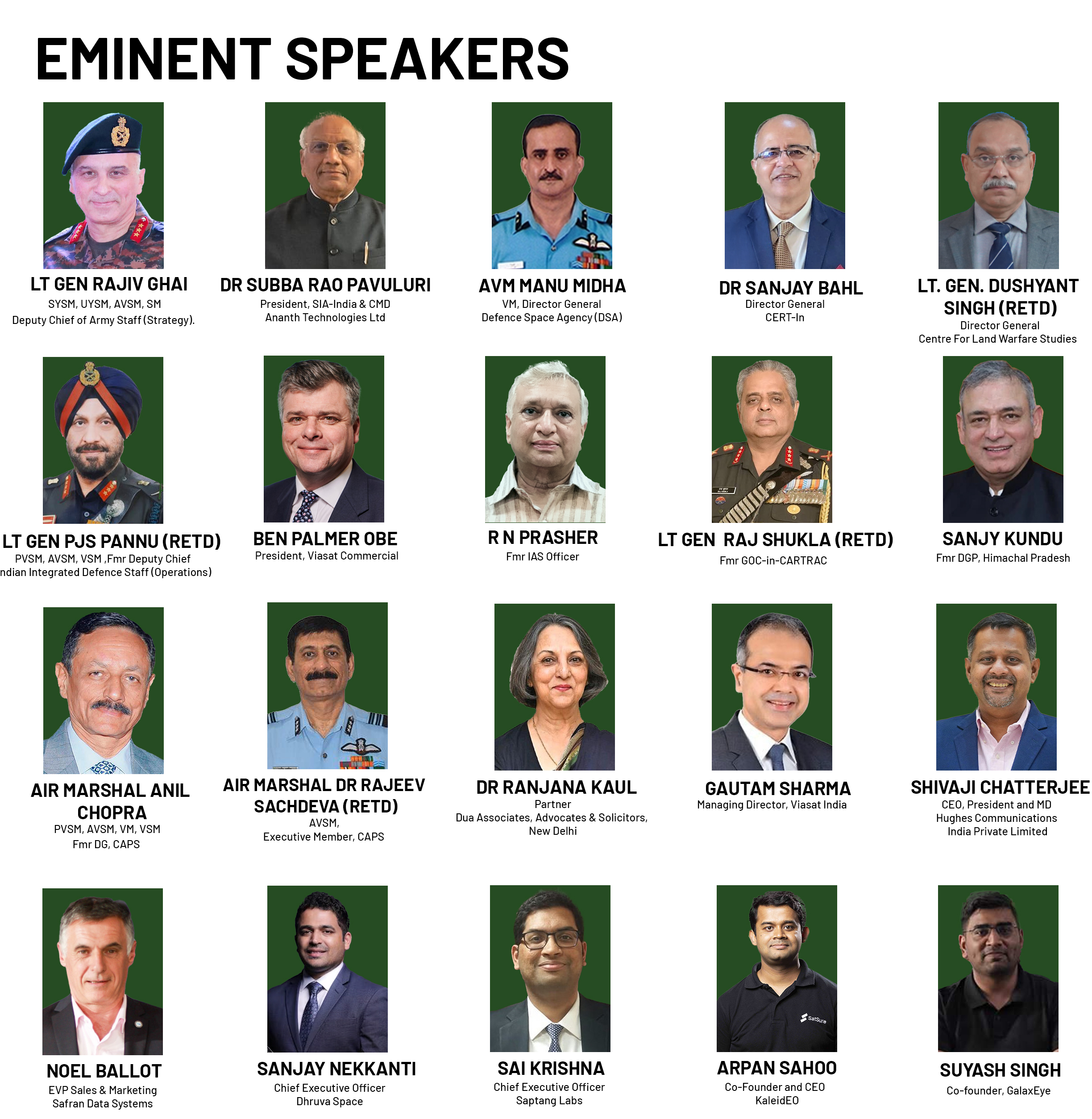
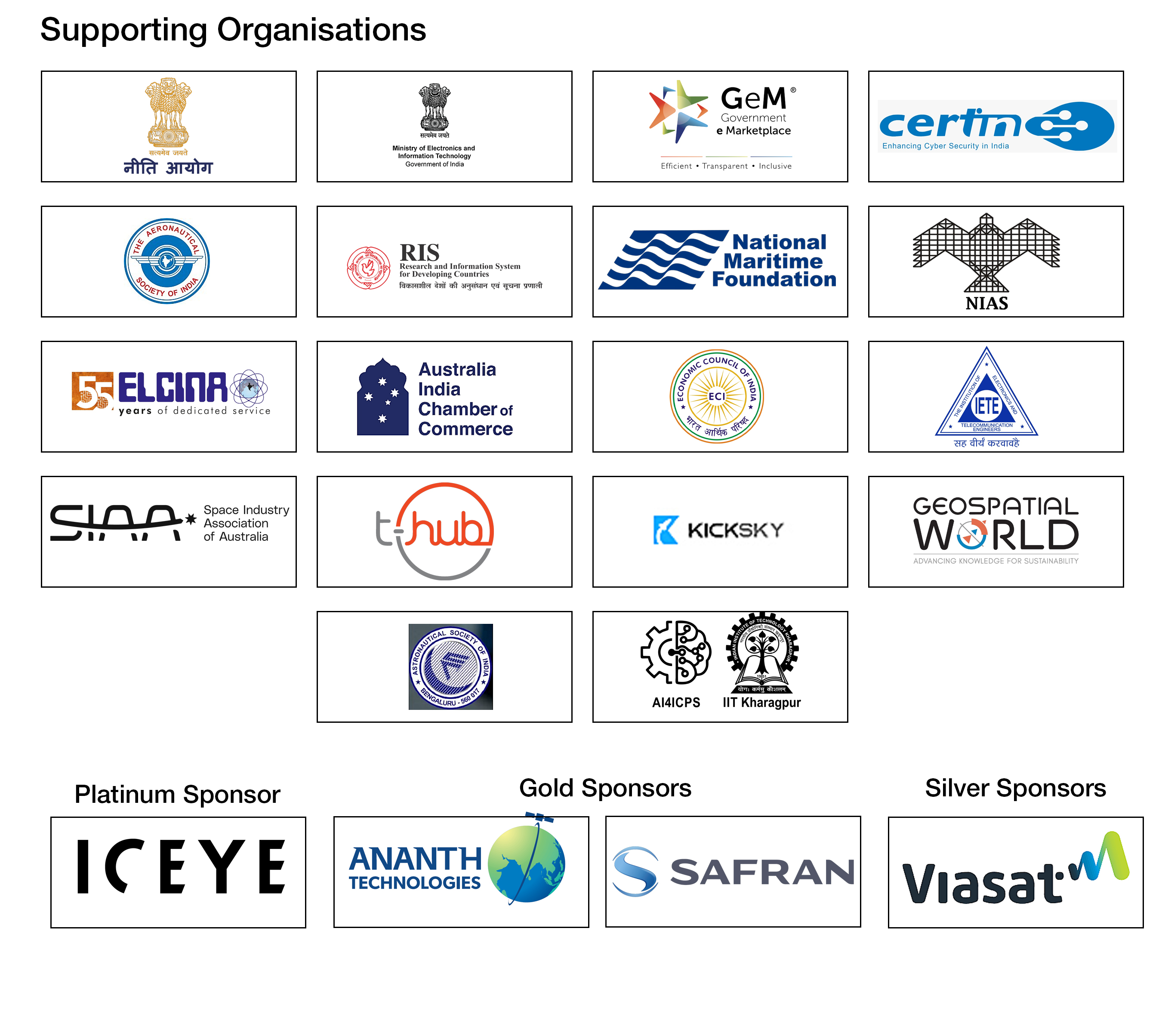
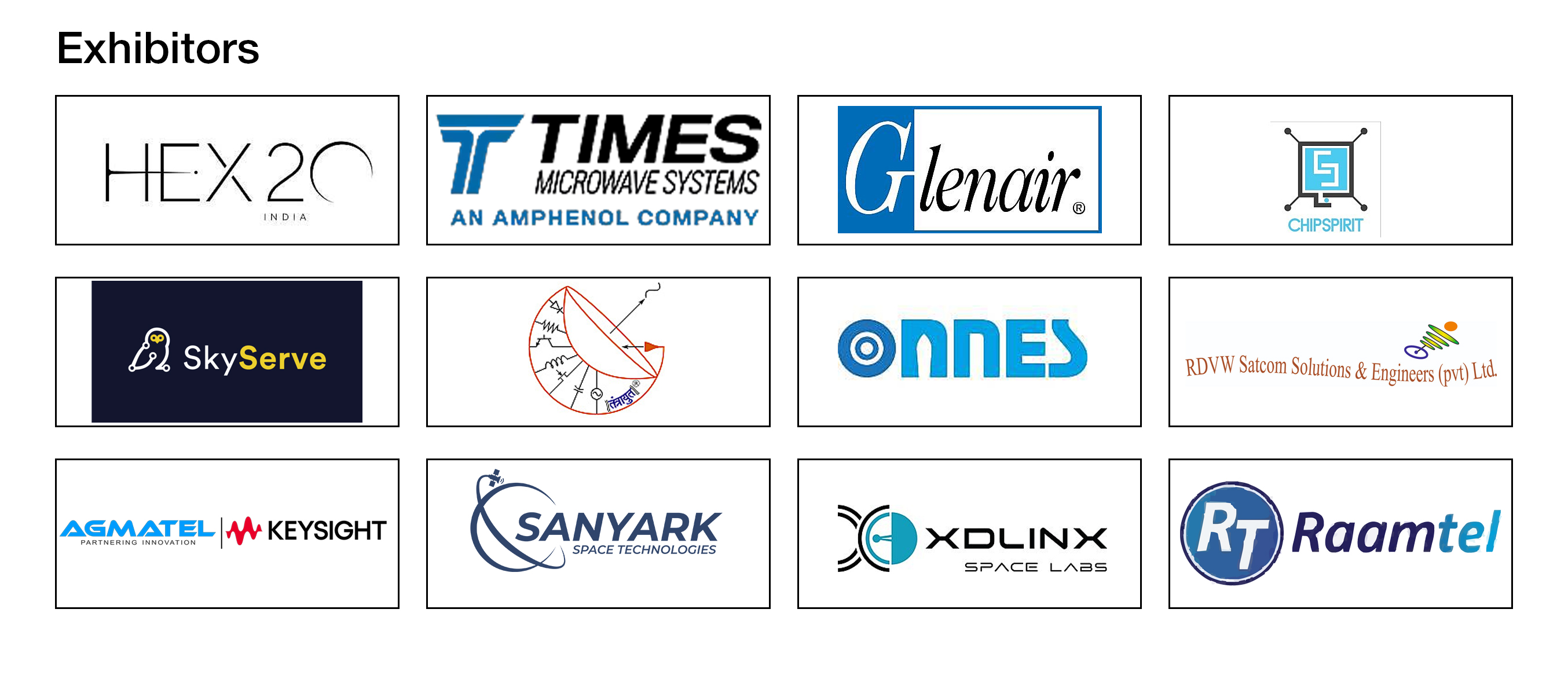
As DEFSAT 2026 approaches, the Conference & Exposition continues to attract strong participation from leading domestic and global players across defence, space, aerospace, satellite communications, cyber, and dual-use technologies. This year’s sponsors and exhibitors reflect the growing convergence of space and national security, reinforcing DEFSAT’s position as India’s premier defence–space dialogue platform.
|
|
|
DEFSAT 2026 Partner Spotlight | Welcoming ICEYE as Platinum Sponsor
|
|
|
|
|
SIA-India is delighted to welcome ICEYE as a Platinum Partner for DEFSAT 2026. A Finland-based space technology leader, ICEYE operates one of the world’s largest synthetic aperture radar (SAR) satellite constellations, delivering persistent, near real-time Earth observation data in all weather and lighting conditions.
Serving customers across more than 70 countries, ICEYE provides actionable intelligence to governments and commercial sectors including defence and intelligence, disaster response, insurance, maritime monitoring, and finance. Its advanced capabilities in rapid-revisit SAR data are redefining situational awareness and operational readiness across domains
|
|
|
DEFSAT 2026 Partner Spotlight | Welcoming Safran as Gold Partner
|
|
|
|
|
SIA-India is pleased to welcome Safran as a Gold Partner for DEFSAT 2026. A global high-technology leader in aerospace, defence, and space, Safran is renowned for designing and manufacturing mission-critical propulsion, avionics, navigation, and advanced aerospace systems. With strong capabilities spanning civil aviation, military platforms, and space access, Safran continues to support governments and industry worldwide in advancing safety, technological excellence, and strategic autonomy.
|
|
|
DEFSAT 2026 Partner Spotlight | Welcoming Ananth Technologies as Gold Partner
|
|
|
|
|
SIA-India is pleased to welcome Ananth Technologies as a Gold Partner for DEFSAT 2026. A leading aerospace and defence manufacturer in India, Ananth Technologies has played a pivotal role in powering the nation’s space and strategic programmes, contributing mission-critical electronic systems to over 107 ISRO satellites and 87 launch vehicles. The company’s technologies are also embedded across key missile platforms, including BrahMos, Akash, and Astra, reflecting its deep integration into India’s defence and space ecosystem.
|
|
|
DEFSAT 2026 Partner Spotlight | Welcoming Viasat as Silver Partner
|
|
|
|
|
SIA-India is delighted to welcome Viasat as a Silver Partner for DEFSAT 2026. A global communications leader, Viasat is dedicated to connecting governments, businesses, and communities worldwide through advanced satellite and integrated network solutions. Leveraging a multi-orbit architecture that combines GEO, NGSO, and terrestrial technologies, Viasat delivers flexible, scalable, and resilient connectivity across land, air, and maritime domains.
|
|
|
DEFSAT 2026 | Welcoming Our Partners
|
|
|
Budget 2026–27: Funding Recovery Signals Stability, Industry Reforms Awaited
|
|
|
|
|
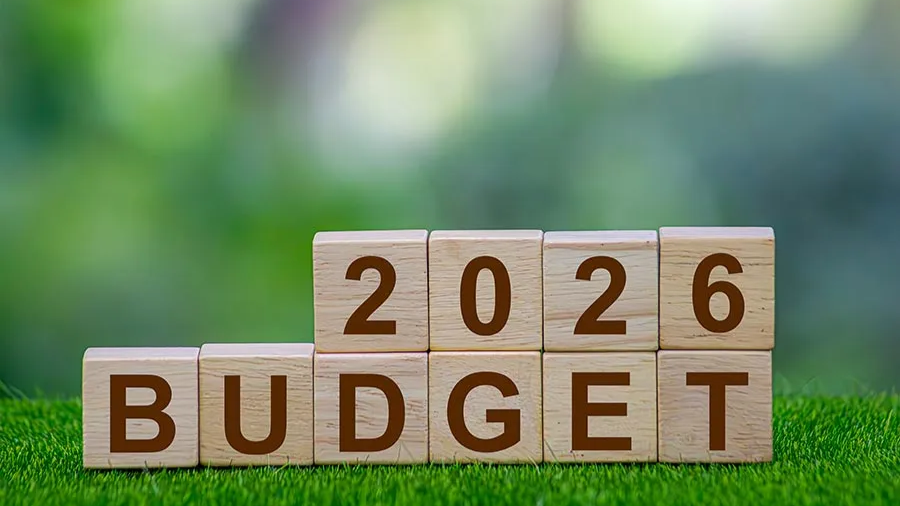
The Union Budget 2026–27 marks a welcome recovery in allocations for the Department of Space, reaffirming the Government of India’s continued commitment to strengthening national space capabilities and strategic programmes. Sustained public investment in launch systems, satellite infrastructure, and next-generation missions provides much-needed stability and reinforces confidence in India’s long-term space ambitions. The sharp increase in BharatNet allocation further signals an accelerated push towards nationwide digital infrastructure, creating a stronger demand environment for satellite communications and space-enabled connectivity alongside terrestrial networks.
At the same time, as articulated in SIA-India’s pre-budget recommendations, the next phase of growth for India’s space economy will hinge on targeted structural reforms to catalyse private sector expansion. The industry had proposed the introduction of a hybrid Production Linked Incentive (PLI) framework tailored for the space sector to support manufacturing, downstream services, and supply-chain localisation. In addition, SIA-India had recommended a calibrated roadmap to progressively enhance India’s space expenditure as a proportion of GDP, aligning investments with the country’s ambition of becoming a major global space economy hub.
While the current budget underscores policy continuity and public-sector support, the absence of dedicated fiscal incentives, financing mechanisms, and procurement-led demand generation for private industry highlights the need for deeper policy alignment. Moving forward, integrating these recommendations into future fiscal and regulatory frameworks will be essential to accelerate commercial participation, strengthen domestic manufacturing, and position India as a globally competitive space power.
|
|
|
Deep-Tech Startups Brought Under Expanded Startup India Framework
|
|
|
|
|
The Government of India has expanded the official definition of startups to include deep-tech firms and extended their recognition period under the Startup India framework from 10 to 20 years. The revised norms also enhance turnover eligibility thresholds, acknowledging the longer development cycles and higher capital requirements associated with advanced technology sectors. The move is expected to benefit startups operating in strategic domains such as space, AI, semiconductors, and advanced communications by enabling sustained access to policy incentives, funding support, and regulatory recognition over a longer horizon.
A core structural challenge for India’s space and deep-tech startups has been the policy–innovation mismatch: while technology development cycles often span 10–15 years, regulatory and fiscal recognition frameworks have historically been aligned to short-term digital or service-led ventures. By extending the recognition window and formally acknowledging deep-tech characteristics, the revised framework begins to address this misalignment and offers greater policy stability for long-gestation, high-capex innovation. SIA-India suggests that this reform should now be complemented by sector-specific measures, including patient capital mechanisms, government-backed demand creation, and streamlined technology procurement pathways, to ensure that extended recognition translates into sustained growth, commercial scale, and global competitiveness for India’s strategic technology enterprises.
Read More:
|
|
Technology and Innovation
|
|
|
|
Indian Startups Emerging as Global Leaders in Strategic and Deep-Tech Innovation
|
|
|
|
|
A new generation of Indian startups is rapidly positioning the country as a global hub for strategic and deep-tech innovation across sectors such as space, defence, AI, semiconductors, and advanced communications. Moving beyond consumer-led growth, these firms are increasingly building foundational technologies with global relevance and national security value.
From satellite launch systems and defence-grade drones to sovereign AI and next-generation communications, Indian startups are developing capabilities critical to infrastructure resilience, technological self-reliance, and future economic competitiveness. This shift reflects a maturing innovation ecosystem focused on long-term strategic technologies that serve both domestic priorities and global markets, reinforcing India’s emergence as a key technology developer on the world stage.
Read More:
|
|
|
SIA-India Signs MoU with Singapore’s Association of Aerospace Industries to Strengthen Bilateral Industry Collaboration
|
|
|
|
|
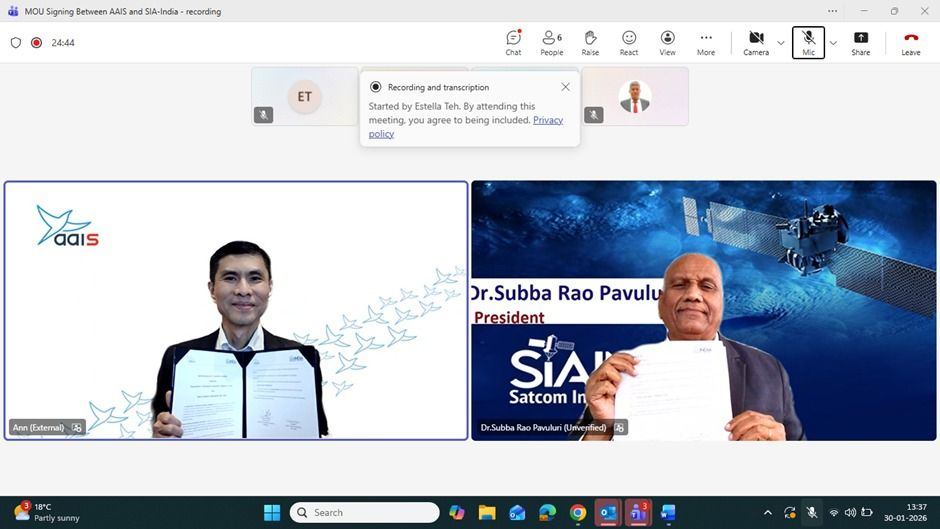
SIA-India has signed a Memorandum of Understanding (MoU) with the Association of Aerospace Industries (Singapore), marking a significant step towards deepening India–Singapore cooperation across the space and aerospace sectors. This partnership comes at a pivotal time as both countries seek to strengthen industry linkages, unlock new business opportunities, and foster collaboration across rapidly evolving space and aerospace value chains.
The MoU will focus on promoting bilateral collaboration in advanced technologies, facilitating industry engagement and B2B interactions, and enabling member-led delegations. It will also support the joint organisation of webinars, workshops, and roundtables on emerging domains, while encouraging research, innovation, and capacity-building initiatives. Through enhanced policy dialogue, regulatory exchange, and joint thought leadership, the partnership aims to build a more connected and resilient India–Singapore space and aerospace ecosystem driven by industry-led collaboration and shared strategic vision.
|
|
|
Farmtech India 2026 to Explore Space-Based Solutions for Agriculture
|
|
|
|
|
Farmtech India 2026, organised by DSS MERI in association with SIA-India and FEED, will be held on 17 February 2026 at the MERI Group of Institutions, New Delhi. The meeting, themed “New Developments and Space-Based Farming Techniques in India – A Strategic Opportunity for the Agriculture and Space Sector,” will bring together agricultural leaders, academic institutions, policymakers, and experts from the space and allied technology sectors. The discussions will examine real-time challenges faced by farmers and explore the application of space technologies in precision farming, weather forecasting, and resource optimisation. The forum will also focus on integrating allied technologies for scalable agri-solutions and developing policy-aligned implementation pathways, with the objective of shaping an actionable roadmap and potential pilot initiatives.
|
Join the Dialogue:
Date: 17 February 2026
Time: 09:45 AM (IST)
Venue: MERI Group of Institutions, Janakpuri, New Delhi
Online participation: Available via Zoom
Kindly confirm participation by 13 February 2026.
To Know More:
|
|
|
SIA-India President to Speak at High-Level Dialogue on India’s Commercial Space Future
|
|
|
|
|
Dr. Subba Rao Pavuluri, President, SIA-India, and Chairman, Ananth Technologies, will be speaking at an upcoming high-level panel discussion titled “Escape Velocity: Powering India’s Next Phase in Space” to be held on 14 February at The Taj Palace, New Delhi.
The discussion will focus on the next phase of India’s space journey, examining how mission-driven technological excellence can be translated into scalable commercial capabilities across launch, satellite services, data analytics, and downstream applications. The panel will explore pathways for converting India’s growing space strengths into export-ready solutions, attracting global investment, and building sustainable markets across sectors such as climate intelligence, logistics, agriculture, and defence.
|
|
|
Gilat Secures $10 Million Order to Support LEO Constellation Infrastructure
|
|
|
|
|
SIA-India member Gilat Satellite Networks has secured an order exceeding $10 million to support the deployment of ground infrastructure for a major Low Earth Orbit (LEO) satellite constellation. The contract, awarded by a leading ground gateway antenna provider, will be executed over the next 12 months and will strengthen global multi-orbit communications capabilities.
The order includes advanced Ka-band solid-state power amplifiers designed to enhance high-capacity gateway operations and ensure reliable connectivity across LEO, MEO, and GEO satellite networks. These technologies play a critical role in enabling next-generation broadband services and resilient satellite communications infrastructure worldwide.
Read More:
|
|
|
SIA-India Thought Leadership
|
|
|
|
Stellar Conversation | Advancing Circular Economy in India’s Telecom Ecosystem
|
|
|
|
|
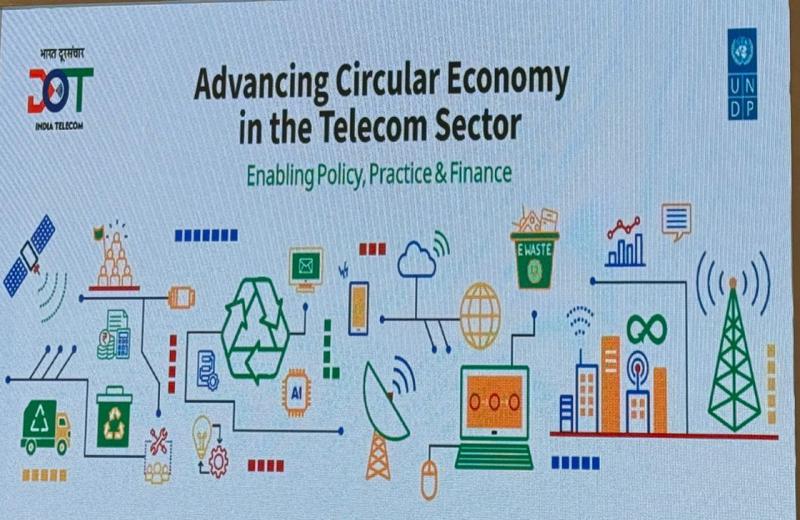
SIA-India’s latest Stellar Conversation features Mr. Kamendra Kumar, Former Director, TCIL, Chairman Tamil Nadu Telecom, and Vice Chairman, TEPC, who calls for reimagining India’s telecom growth through a circular economy approach in his article “Advancing Circular Economy in the Telecom Sector: Enabling Policy and Practice.”
The piece highlights that telecom has evolved into critical national digital infrastructure underpinning governance, economic growth, and strategic resilience. With rapid expansion in 5G, fibre networks, data centres, and satellite-enabled connectivity, traditional linear models of infrastructure deployment are becoming increasingly unsustainable.
Mr. Kumar emphasises that adopting circular economy principles, including asset life extension, reuse, modular design, and responsible end-of-life management, can significantly reduce costs, curb e-waste, and strengthen supply-chain resilience while lowering import dependence. The article underscores the need for India’s digital expansion to transition towards intelligent reuse models where sustainability, affordability, and strategic autonomy reinforce one another.
Read More:
|
|
|
Stellar Conversation | Orbital Stewardship in the Post-Kessler Era
|
|
|
|
|
SIA-India’s latest Stellar Conversation features Dr. Abhiram Nair’s thought-provoking piece on “Orbital Stewardship in the Post-Kessler Era,” highlighting the growing urgency of responsible behaviour in Earth’s increasingly congested orbital environment.
The article underscores that as space becomes more crowded and debris-laden, sustainable space activity must go beyond regulatory compliance to embrace active stewardship and long-term accountability. It calls for stronger policy evolution, technological innovation, and global cooperation to safeguard orbital space as critical shared infrastructure.
By examining governance gaps, emerging debris-management technologies, and the future of responsible orbital operations, the piece makes a compelling case for placing orbital stewardship at the core of how new-age spacefaring nations and commercial actors approach the next phase of space activity.
Read More:
|
|
|
|
|
“DEFSAT has today become one of the most important platforms for dialogue between the space and defence communities, and this year we are looking to achieve even bigger milestones. With the renewed national focus reflected in the Union Budget and the rapid growth of India’s private space ecosystem, DEFSAT 2026 will bring together global partners, industry leaders, and government stakeholders to build meaningful collaborations and tangible outcomes. We want this edition to go beyond discussions, to enable real partnerships, real capabilities, and real progress for India’s strategic space future.”
|
Mr Anil Prakash
Director General, SIA-India
|
|
|
|
|
DefSat 2026: Strengthening National Security through Space Innovation
|
Experts and policymakers will convene at the DefSat-2026 conference (Feb 24–26) to integrate space technology into India's military doctrine. The event focuses on treating space as critical infrastructure and features IndSpaceX 4.0, a pioneering industry-led wargame designed to test resilience in contested environments.
|
|
|
|
|
Budget 2026: Space Industry Pushes for Strategic Infrastructure Status
|
India's private space sector is urging the government to grant "Critical Infrastructure" status in the upcoming budget to unlock low-cost financing. Companies are seeking assured government procurement mandates and fiscal incentives to de-risk deep-tech investments and accelerate the indigenous manufacturing of satellites and launch vehicles.
|
|
|
Other National and International News
|
|
|
|
|
|
Gaganyaan: ISRO Prepares for First Uncrewed Mission
|
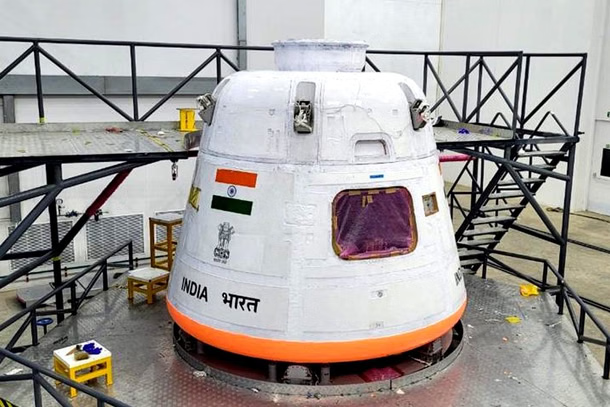
ISRO Chairman S. Somanath announced that the space agency is actively working toward the first uncrewed flight of the Gaganyaan program. This critical milestone will test the orbital module, propulsion systems, and recovery procedures to ensure safety for future crewed missions.
|
|
|
|
|
A Call for Sustainability in Space Exploration
|
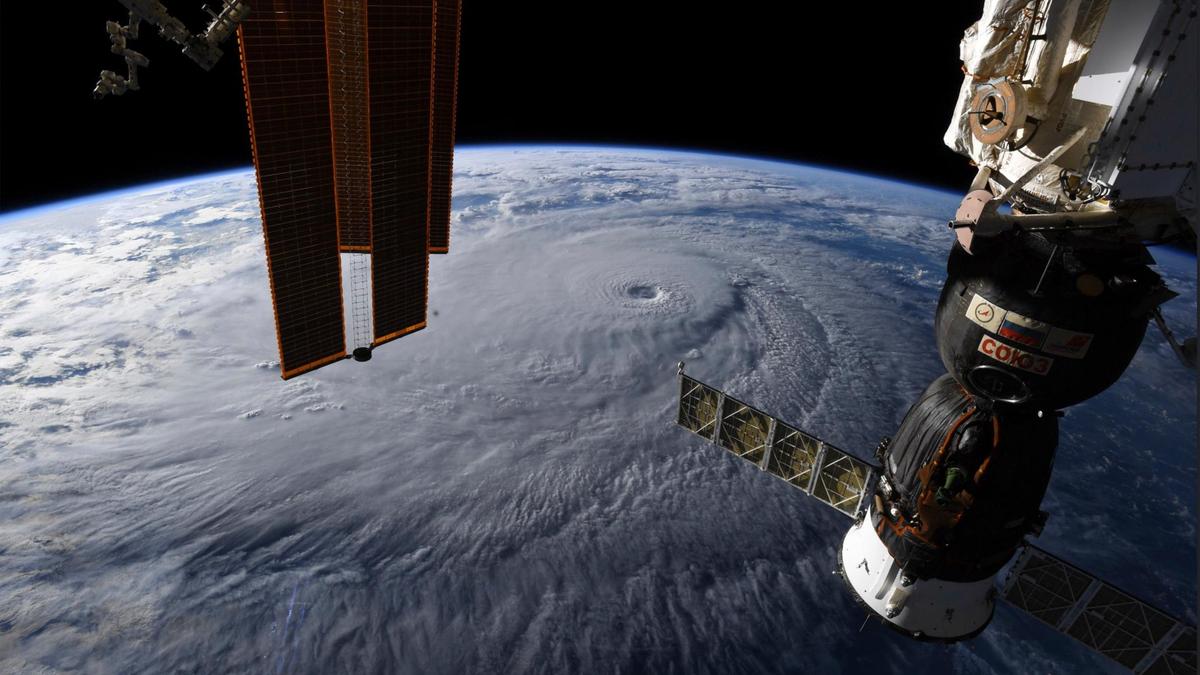
Global space leaders are emphasizing the urgent need for sustainable practices to mitigate the growing threat of orbital debris. The initiative advocates for international cooperation in space traffic management and the development of technologies to ensure long-term access to Earth’s orbits.
|
|
|
|
|
The End of an Era: International Space Station Deorbit
|
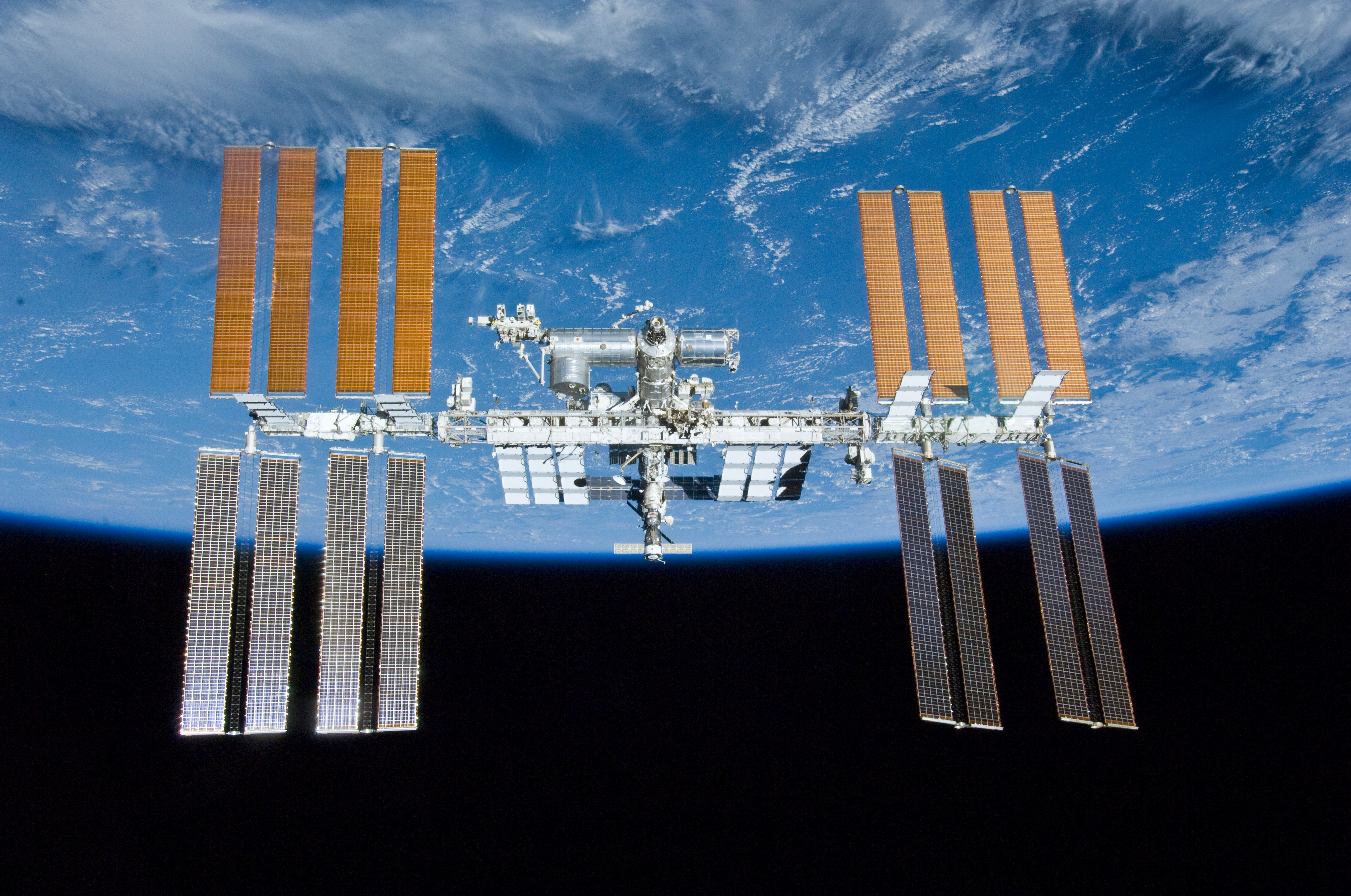
The International Space Station (ISS) is preparing for its final descent, marking the conclusion of decades of global scientific collaboration. Plans are underway for a controlled re-entry into the Pacific Ocean, shifting the focus toward commercial space stations and deep-space exploration.
|
|
|
|
|
Indian Space Sector Targets Growth Surge in 2026
|
Following a year of record achievements, India’s private space industry is eyeing significant investment growth and expanded operations in 2026. Experts anticipate a rise in satellite launches and downstream applications as the government continues to liberalize the sector for global competitiveness.
|
|
|
|
|
|
|
|
|
|
For further information, please contact us at:
|
|
|
|
|
|
|
|
|
|
|
|