Click Here to View online version
|
|
|
SIA-India Newsletter – November 2025 Second Edition
|
|
|
SIA-India Calls for Ambitious Fiscal Push in Budget 2026 to Strengthen India’s Space Ecosystem
|
|
|
|
|
The Space Industry Association of India (SIA-India) has formally submitted its consolidated Pre-Budget Memorandum for FY 2026–27 to the Ministry of Finance, outlining a decisive fiscal roadmap to strengthen India’s space capabilities. The submission — prepared in collaboration with KPMG and based on extensive industry consultations — urges the government to triple the national space budget toward 0.12% of GDP, expand public investment, and position space as critical national infrastructure.
Key recommendations include:
- A multi-year expansion of India’s space budget, moving gradually towards globally competitive benchmarks.
- A Hybrid PLI Scheme for space manufacturing, tailored for long-cycle, high-precision production.
- Dedicated HSN/SAC codes for space-grade components to resolve tax ambiguities and unlock ITC.
- Predictable customs exemptions and specialised clean-room inspection zones for mission-critical hardware.
- A National Satellite Connectivity Mission to serve remote, underserved, and disaster-prone regions.
- Reforms to strengthen FDI, joint ventures, testing infrastructure, and deep-tech R&D pathways.
In addition to the consolidated submission to the Finance Ministry, SIA-India has submitted separate, domain-specific recommendations to the relevant line ministries including IN-SPACe, DOS/ISRO, DoT, TRAI, DST, MoD, MIB, MoES, addressing manufacturing, digital communications, customs processes, and strategic infrastructure requirements. The Association emphasised that with global space budgets rising sharply, maintaining the status quo is no longer sustainable, and timely fiscal intervention is essential for India to secure its place in global supply chains.
Read the submissions:
|
|
|
SIA-India Joins Third-Country Industry Coalition on the EU Space Act
|
|
|
|
|
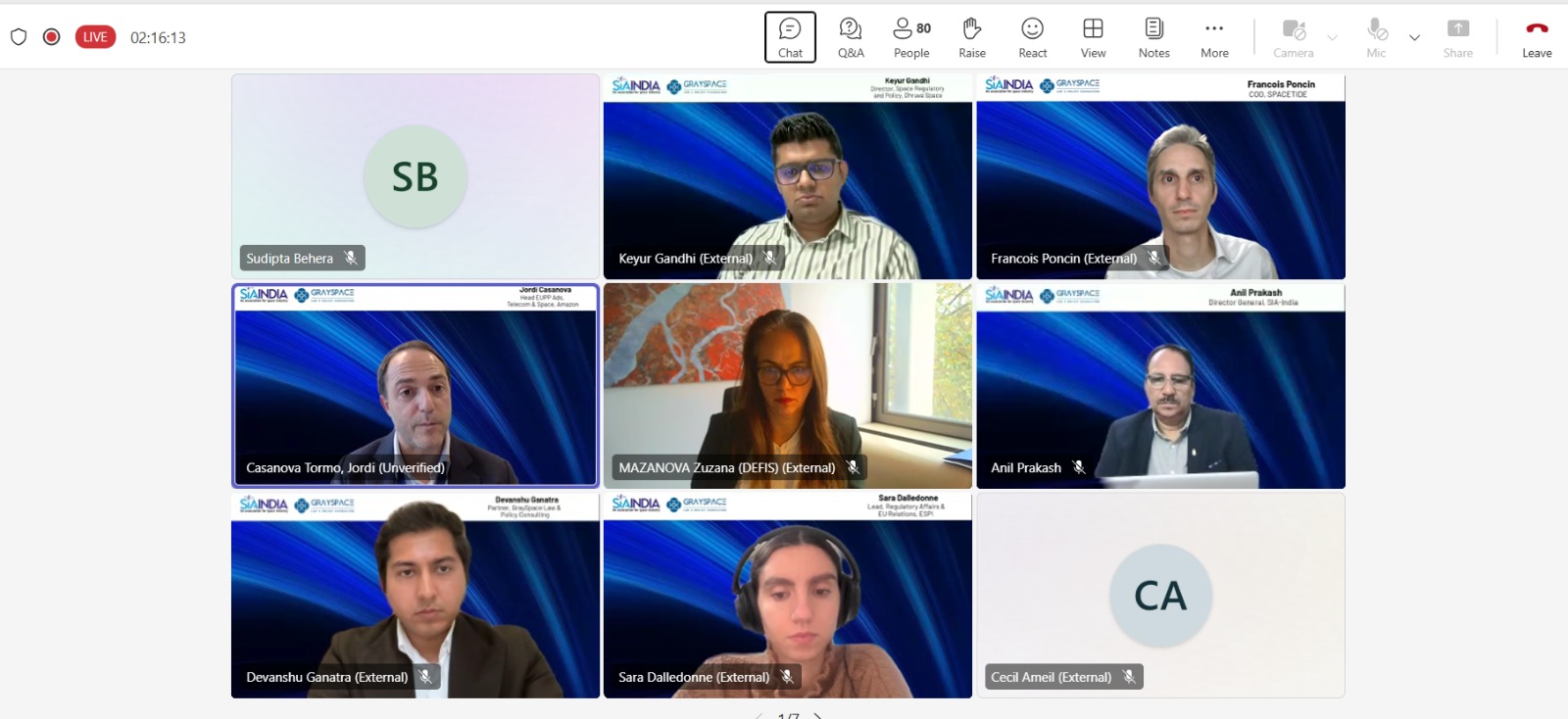
SIA-India has joined a group of third-country space industry associations in submitting a Joint Call to the European Commission, the European Parliament, and the Council of the European Union on the evolving EU Space Act. The statement, coordinated by Grayspace Law and Policy Consulting (Brussels), consolidates perspectives from multiple non-EU associations on the importance of ensuring regulatory interoperability, recognition of equivalent standards, and continued cross-border cooperation within the European space framework.
The joint submission emphasises that Europe’s space ecosystem has long relied on international partnerships and globally aligned regulatory approaches. It highlights concerns that stringent or non-equivalent requirements could unintentionally restrict trusted third-country operators and limit Europe’s access to competitive and innovative services. The signatories call for risk-based, proportionate regulations, transparent authorisation pathways, and structured engagement with international industry stakeholders as the Act moves forward.
This initiative follows SIA-India’s earlier input during the EU Space Act public consultation and participation in related policy dialogues. By joining this consolidated industry position, SIA-India contributes to ensuring that emerging global regulatory frameworks remain open, predictable, and interoperable—principles essential for a resilient international space economy.
|
|
|
DRDO Finalising New Start-up Engagement Policy to Strengthen Defence R&D
|
|
|
|
|
The Defence Research and Development Organisation (DRDO) is finalising a new policy aimed at streamlining start-up and private-sector participation in defence R&D, according to the Ministry of Defence. The policy will formalise standard operating procedures for industry access to DRDO laboratories and test facilities, making collaboration clearer, faster and more transparent. It builds on wider reforms such as free technology transfer of select DRDO technologies, zero-fee access to patents for Indian manufacturers, and an expanded Technology Development Fund (TDF), which has received an additional ₹500 crore to support MSMEs and start-ups working on high-end defence technologies. The Ministry noted that DRDO has sanctioned 148 R&D projects over the past three years, and the new policy aims to further accelerate innovation-driven engagement across the ecosystem.
Although the policy is targeted at defence R&D, it carries strong spillover benefits for India’s space industry. Many DRDO test facilities — especially in electronics, materials, sensors, EMI/EMC, propulsion, and high-reliability systems — are directly relevant to satellite, launch and payload development. Streamlined access for start-ups and MSMEs will reduce testing bottlenecks, lower costs for space-grade qualification, and accelerate dual-use technology development in critical areas such as advanced materials, AI-driven autonomy, precision navigation, and hardened electronics. As the space and defence domains increasingly converge, the policy positions India’s private space sector to benefit from stronger R&D infrastructure and deeper innovation pipelines.
|
|
|
Karnataka Releases First Standalone Space Technology Policy, Targets USD 3 Billion in Investments.
|
|
|
|
|
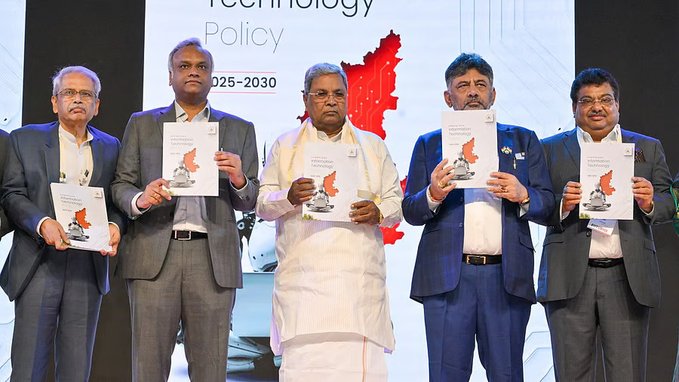
Karnataka has introduced the Karnataka Space Technology Policy 2025–2030, the country’s first standalone state-level space policy, setting a target of USD 3 billion (₹25,000 crore) in space-sector investments over the next five years. As reported by the Times of India, the policy aims to position Karnataka as the leading hub for space innovation, manufacturing, and commercialisation, with the state aspiring to capture 50% of India’s space market and 5% of the global market share by 2030.
SIA-India participated in the draft consultation process, and several of the Association’s recommendations have been incorporated into the final policy document. Anchored around five strategic pillars — Skill Development, Investments, Infrastructure, Innovation, and Adoption — the policy lays a robust framework for strengthening the state’s space ecosystem and deepening support for start-ups, MSMEs, academia, and industry.
A key highlight is the establishment of a Centre of Excellence for Space Technology, to be developed in partnership with SIA-India under the aegis of the Karnataka Innovation and Technology Society (KITS). The Centre will serve as a focal point for industry–academia collaboration, R&D, technology transfer, capability development, and facilitation support for emerging companies, further bolstering India’s commercial and defence-space capabilities. The policy marks a significant step in advancing state-driven leadership in the NewSpace era and reinforces the growing importance of coordinated industry–government collaboration in shaping India’s space growth trajectory.
To Know more:
|
|
|
Technology and Innovation
|
|
|
|
ISRO Successfully Validates Main Parachute System for Gaganyaan Crew Module
|
|
|
|
|
India’s human spaceflight programme took a major step forward as ISRO completed a critical test of the main parachute system for the Gaganyaan crew module on November 3, 2025, at the Babina Field Firing Range, Jhansi. The drop test — part of the ongoing Integrated Main Parachute Airdrop Test (IMAT) series — used a mass-equivalent dummy module released from 2.5 km altitude via an Indian Air Force IL-76 aircraft.
The parachute system, comprising ten parachutes of four different types, executed the full descent sequence: after drogue and pilot parachutes stabilized the module, the main parachutes deployed via reefed inflation — successfully slowing and guiding the module to a stable, soft landing. Critically, the test demonstrated robustness even under asymmetric deployment conditions, validating the system under one of its most challenging load scenarios. This milestone brings Gaganyaan one step closer to certifying a safe re-entry and landing system for crewed missions, reinforcing India’s growing technical prowess in human spaceflight.
|
|
|
SIA-India and DPIIT to Host Space Industry Workshop on PM GatiShakti Geospatial Integration
|
|
|
|
|
SIA-India, in collaboration with the Department for Promotion of Industry and Internal Trade (DPIIT), is organising a hybrid Space Industry Workshop on Harnessing the Power of PM GatiShakti, aimed at strengthening industry participation in India’s evolving geospatial ecosystem. The initiative follows DPIIT’s decision to enable private-sector access to selected data layers from the PM GatiShakti National Master Plan (NMP) through the Unified Geospatial Interface (UGI).
The UGI platform provides authenticated, multi-sector infrastructure datasets — spanning transport, logistics, land, utilities and social infrastructure — developed by BISAG-N and hosted on the National Geospatial Data Registry (NGDR). This expanded access marks a major step toward data-driven planning and is expected to accelerate innovation across geospatial, satellite, and infrastructure-focused industries.
The workshop will:
- Introduce the PM GatiShakti UGI platform and its data-access framework.
- Provide a technical demonstration of data layers, analytical modules and operational workflows.
- Highlight use cases where satellite data and geospatial intelligence enhance infrastructure planning and efficiency.
- Enable direct interaction with DPIIT and BISAG-N to explore pilot projects and capacity-building opportunities.
- A National Satellite Connectivity Mission to serve remote, underserved, and disaster-prone regions.
- Reforms to strengthen FDI, joint ventures, testing infrastructure, and deep-tech R&D pathways.
The workshop will be conducted in a hybrid format, with limited in-person participation based on submitted preferences. Interested participants may register using the following link:
Registration link:
|
|
|
SIA-India Participates in India–Australia Business Summit to Advance Space and Defence Collaboration
|
|
|
|
|
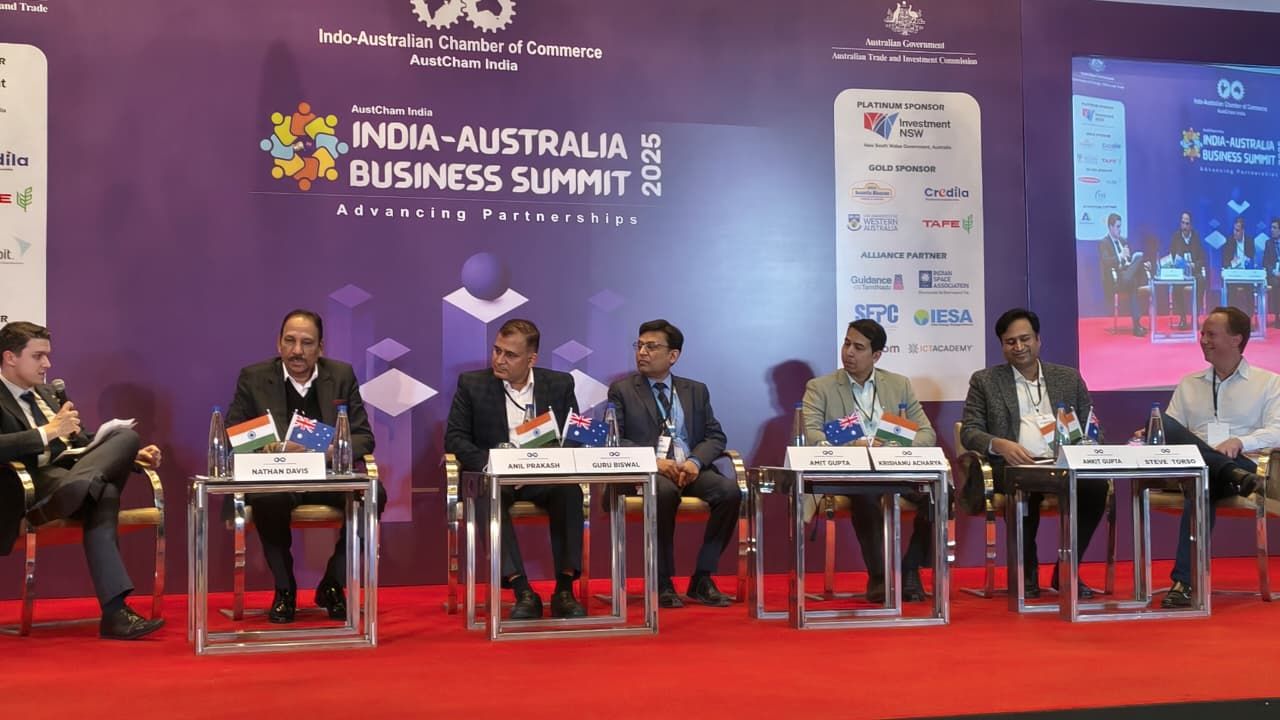
SIA-India participated in the Auscham India | India–Australia Business Summit 2025, where Director General Mr. Anil Prakash joined a panel discussion on “Space & Defence: Building Indo–Australian Collaborations.” The session underscored the growing strategic alignment between the two countries and the expanding role of industry in shaping a modern partnership.
Discussions highlighted strong potential for joint initiatives in space situational awareness (SSA), Earth Observation, climate monitoring, and hosted payloads, leveraging India’s satellite and launch strengths alongside Australia’s advanced ground infrastructure. Speakers noted that both nations are well positioned to collaborate on resilient, secure, and innovation-driven solutions for the Indo-Pacific.
The summit reaffirmed that deeper industry engagement, harmonised regulatory frameworks, and shared technological ambition will be central to advancing India–Australia cooperation in space and defence
|
|
|
SIA-India and Roscosmos Discuss New Avenues for India–Russia Space Cooperation
|
|
|
|
|
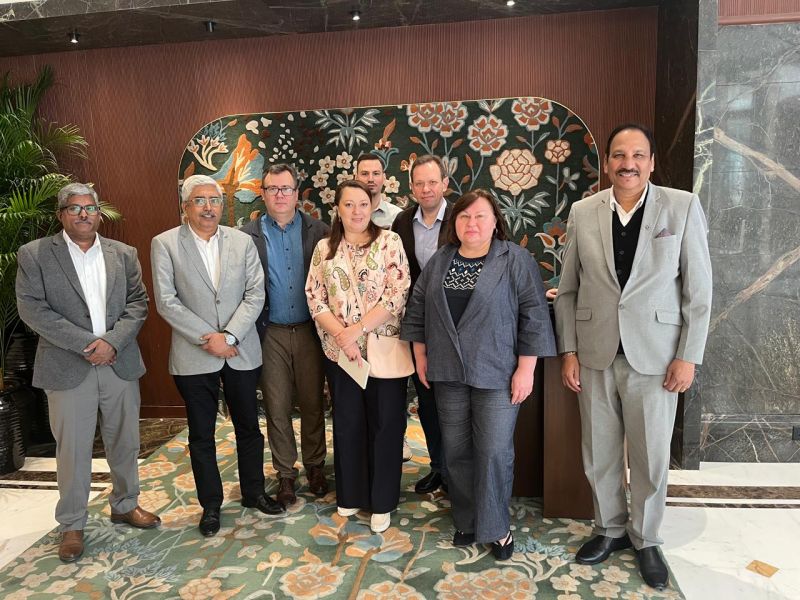
SIA-India held a focused interaction with a delegation from Roscosmos to explore potential collaboration across key space domains, including ground station support, satellite launch services, human spaceflight technologies, and emerging areas such as 3D bioprinting. SIA-India also invited the delegation to participate in the upcoming DefSat Conference & Expo and the India Space Congress, marking a step toward deeper engagement within the global space ecosystem.
|
|
|
Skyroot Unveils India’s First Private Commercial Orbital Rocket at New Infinity Campus
|
|
|
|
|
SIA-India member Skyroot Aerospace has achieved a major milestone with the unveiling of Vikram-I, India’s first privately developed commercial orbital rocket, during the inauguration of the company’s new 200,000 sq. ft Infinity Campus in Hyderabad by the Hon’ble Prime Minister. The state-of-the-art facility enables end-to-end design, integration, and testing of orbital-class launch vehicles and is geared to support a production capacity of up to one rocket per month.
Vikram-I is designed to serve the growing global small-satellite launch market, offering rapid, cost-efficient access to space for domestic and international customers. The Prime Minister noted that developments such as these underscore India’s emergence as a competitive player in the global satellite-launch ecosystem.
|
|
|
Agnikul Cosmos Secures USD 17 Million to Accelerate Reusable Launch Vehicle Development
|
|
|
|
|
SIA-India member Agnikul Cosmos has raised USD 17 million in its latest funding round, backed by investors including Advenza Global Limited, HDFC Bank, Pratithi Investments, Artha Venture Fund, and others. The announcement follows the strong industry response to Agnikul’s recent controlled ascent test launch, which has generated significant customer interest for upcoming missions.
With this new funding, the company will expand operations at the land recently allocated near the upcoming Kulasekarapatnam launchpad, supported by the Government of Tamil Nadu. Agnikul also reaffirmed its commitment to rapidly advancing reusable launch vehicle technologies, noting that reusability is now a key objective for its next mission—strengthened by continued collaboration with ISRO and IN-SPACe.
|
|
|
Ananth Technologies Launches Centre of Excellence for Navigation in Thiruvananthapuram
|
|
|
|
|
SIA-India member Ananth Technologies, led by SIA-India President Dr. Subba Rao Pavuluri, has inaugurated a new Centre of Excellence for Navigation in Thiruvananthapuram — the first-of-its-kind private-sector navigation hub in the country. The Centre represents a significant advancement in strengthening India’s indigenous Positioning, Navigation & Timing (PNT) capabilities.
The facility will focus on developing high-precision inertial sensors, quantum sensors, and next-generation navigation systems, alongside AI-driven fusion algorithms that integrate GNSS, INS, vision, and radar for resilient, multi-modal navigation solutions. The Centre aims to support a wide range of civil and defence applications across aerospace, satellite systems, national security, and strategic PNT requirements.
The initiative will also drive collaborative R&D, talent development, and system integration in partnership with ISRO, DRDO, and leading academic institutions, positioning the Centre as a critical enabler in India’s growing navigation and space systems ecosystem.
|
|
|
Inmarsat Maritime Strengthens NexusWave Service with Next-Gen VS60 Terminal and ViaSat-3 Satellites
|
|
|
|
|
SIA-India member Inmarsat Maritime has announced a major upgrade to its bonded connectivity service, NexusWave, with the introduction of the new VS60 maritime terminal and upcoming integration of the high-capacity ViaSat-3satellite constellation.
The enhanced NexusWave service is expected to deliver significantly higher bandwidth — including download speeds exceeding 250 Mbps as demonstrated in sea-trials — while combining GEO Ka-band, LEO, LTE and L-band networks into a single, seamless connectivity package. This advancement will support data-intensive applications at sea, improve crew welfare and digitalisation of maritime operations, and reinforce Inmarsat Maritime’s commitment to global, secure communications for fleets across oceans.
|
|
|
|
|
“As India prepares for Budget 2026, it is imperative that fiscal policies reflect the strategic value of space as a growth multiplier. Rationalising taxation, incentivising private participation, and ensuring sustained funding will be key to positioning India’s space economy as globally competitive and innovation-driven.”
|
Mr Anil Prakash
Director General, SIA-India
|
|
|
|
|
Triple Budgetary Support for Space Sector
|
The Satcom Industry Association of India (SIA-India) has urged the Finance Minister to triple the budgetary allocation for the space sector (from 0.04% to 0.12% of GDP) over three budgets and called for a Hybrid Production-Linked Incentive (PLI) scheme to attract global investment.
|
|
|
|
|
SIA-India Pushes Bold Budget, Hybrid PLI
|
SIA-India also recommended a National Satellite Connectivity Mission backed by the Universal Service Obligation Fund (USOF) for digital inclusion in remote areas, and sought streamlined customs exemptions for critical space hardware.
|
|
|
Other National and International News
|
|
|
|
|
|
ISRO Exhibition Draws High Turnout
|
A 3-day Vikram Sarabhai Space Exhibition by ISRO at Rajasthan Technical University, Kota, featuring models of Chandrayaan and Mangalyaan, saw a large turnout of students, showcasing India's space capabilities.
|
|
|
|
|
Defence Stocks Outlook Strong (HAL, BDL, BEL)
|
Brokerage firms maintain a strong outlook on key defence stocks like HAL, BDL, and BEL due to a healthy order book, accelerated indigenous programs (e.g., LCA Mk1A, QRSAM), and positive management commentary on improved ordering in H2FY26 and strong export potential.
|
|
|
|
|
|
|
|
|
|
For further information, please contact us at:
|
|
|
|
|
|
|
|
|
|
|